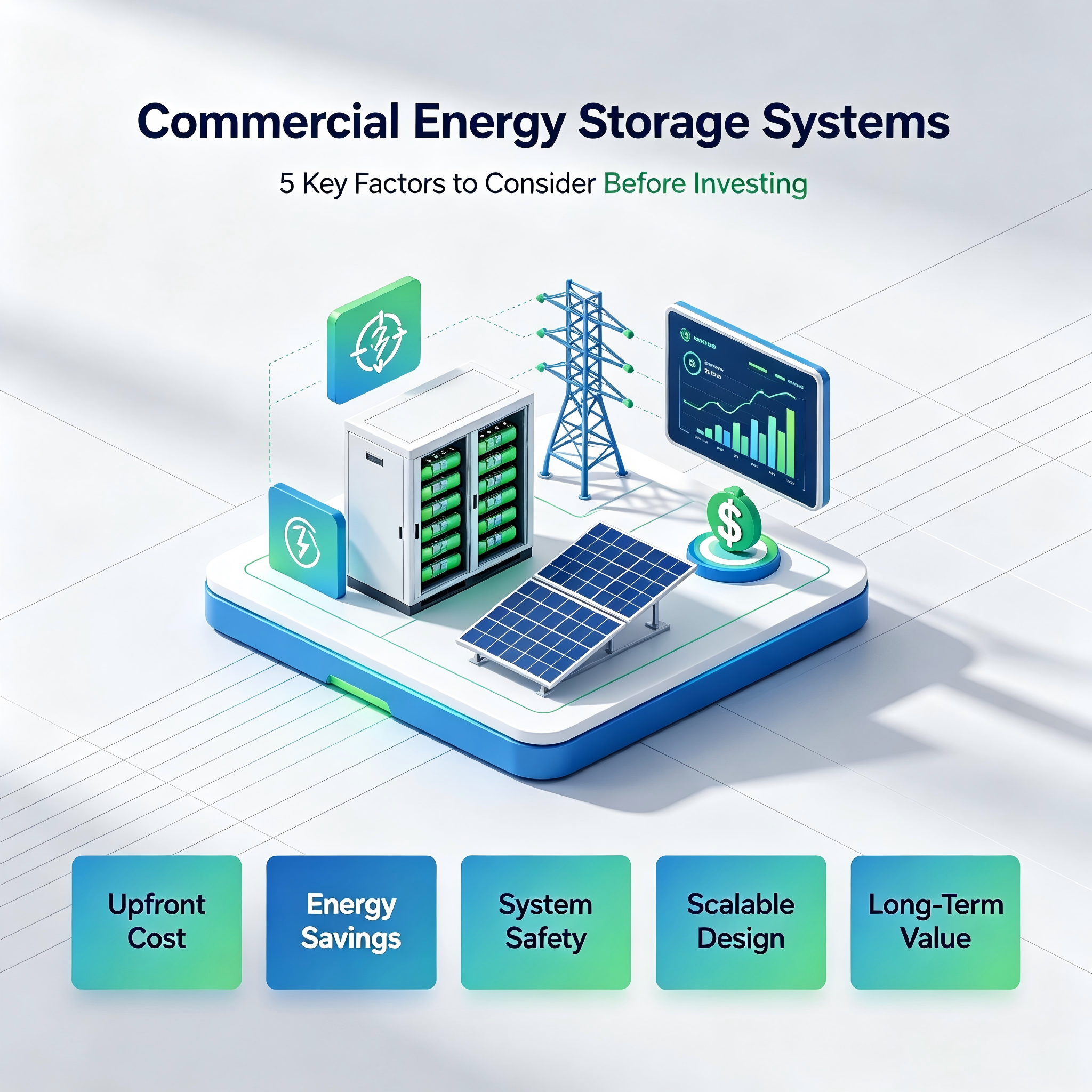
Commercial Energy Storage Systems: 5 Key Factors to Consider Before Investing
- Share
- Issue Time
- Jul 10,2026
Summary
5 critical factors for commercial and industrial energy storage investment — use case, sizing, battery chemistry, EMS compatibility, and warranty.
Commercial and industrial (C&I) energy storage is experiencing unprecedented growth. Driven by rising electricity prices, increasing power reliability demands, and the global push toward net-zero operations, more factories and commercial buildings are installing battery systems than ever before.
But a commercial energy storage system is a significant capital investment. Before you commit, here are the 5 factors that determine whether your system delivers ROI or becomes an expensive paperweight.
1. Understand Your Primary Use Case
Energy storage is not one-size-fits-all. Your use case determines system size, battery chemistry, inverter type, and regulatory compliance requirements.
| Use Case | System Characteristic | Typical ROI Driver |
|---|---|---|
| Peak Shaving | Discharge during high-tariff periods | Reduced demand charges |
| Load Shifting | Charge off-peak, discharge on-peak | Arbitrage of time-of-use rates |
| Backup Power | Instant switchover, full building cover | Avoided downtime cost |
| PV Self-Consumption | Store excess solar, use at night | Reduced grid export/import |
2. Sizing: The Goldilocks Problem
Oversizing wastes capital. Undersizing leaves money on the table. The right size depends on two numbers:
- Energy capacity (kWh): How much total energy do you need to store? For peak shaving, analyze your demand profile for the top 10% of demand peaks.
- Power rating (kW): How fast do you need to deliver that energy? A 100 kWh system at 50 kW delivers 2 hours of discharge; at 100 kW it delivers 1 hour.
Rule of thumb: For most C&I applications, a 2–4 hour discharge duration offers the best ROI.
3. Battery Chemistry and Safety Certification
For commercial installations, safety is non-negotiable. Lithium Iron Phosphate (LiFePO4) is the industry standard because of its highest thermal stability among lithium chemistries.
Your system must have:
- UL1973 / IEC62619 certification (cell level)
- UL9540 / IEC62477 certification (system level)
- Multi-layer BMS protection with cell-level voltage and temperature monitoring
- Active fire suppression (required in many jurisdictions for >100 kWh systems)
4. Inverter and EMS Compatibility
The battery is only half the system. The inverter and Energy Management System (EMS) determine how intelligently the system operates.
Key EMS capabilities to look for:
- Automatic peak shaving: System learns your demand pattern and optimizes discharge timing
- Weather-aware scheduling: Adjusts charging strategy based on PV forecast
- Remote monitoring: Web dashboard with real-time status, alerts, and historical data
- Open communication protocols: Modbus RTU/TCP, CAN, IEC61850 for BMS integration
5. Warranty and Performance Guarantee
Commercial storage warranties typically cover throughput warranty, capacity retention, and round-trip efficiency. Red flag: If a supplier offers only a "time-based" warranty without throughput or capacity guarantees, the warranty may be nearly worthless.
The Vodloon C&I Storage Approach
- VSR / VSC / VSI product families covering 5 kWh to 1 MWh+
- Pre-engineered system designs reduce on-site installation time by up to 40%
- Cloud-based EMS platform with AI-driven optimization and 24/7 monitoring
- Full certification suite: UL, IEC, UN38.3, and CE
Our engineering team has delivered 200+ commercial storage projects across 30+ countries. Contact us for a free site assessment and ROI analysis →